
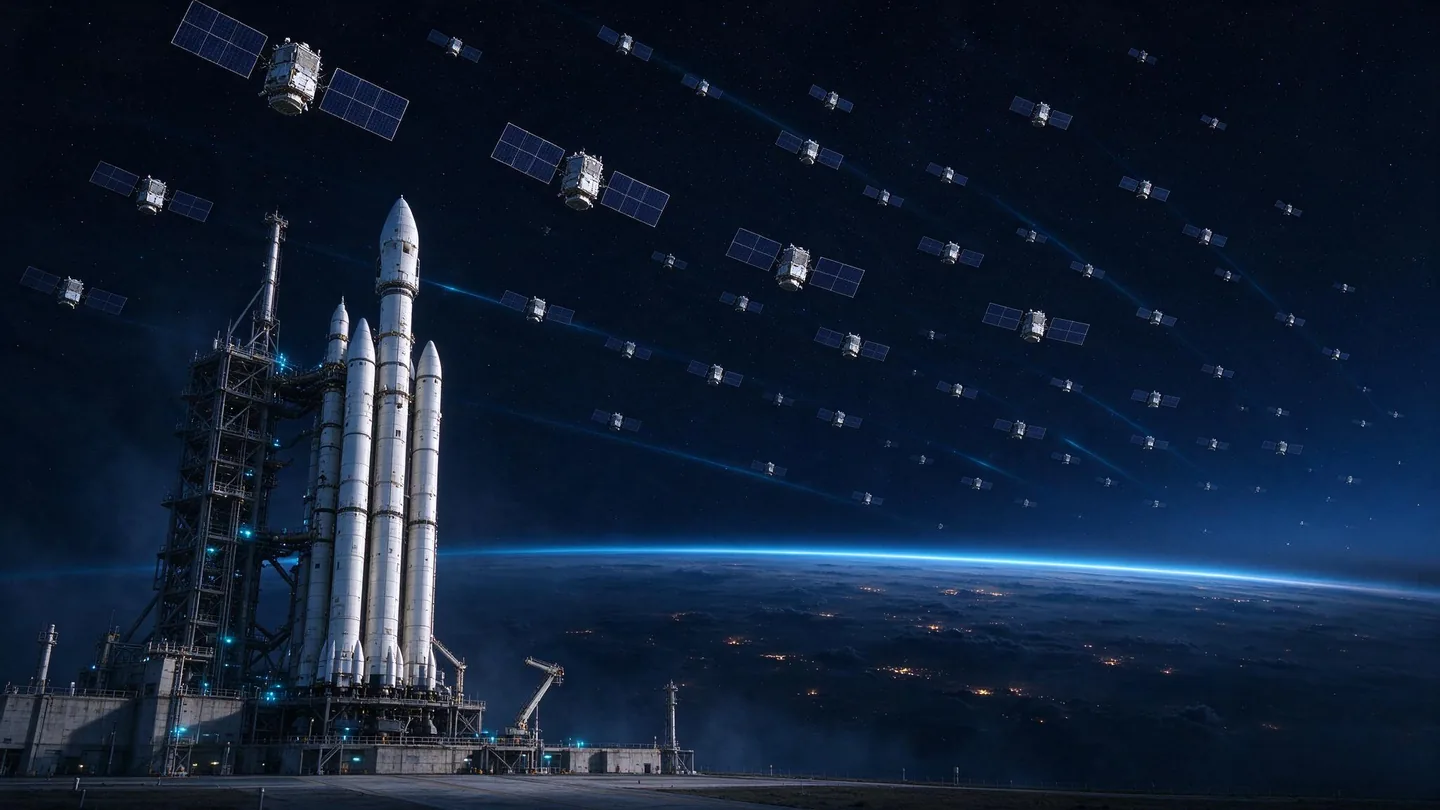
On October 8, Amazon said it had built its 1,000th satellite for Amazon Leo, its low-Earth-orbit broadband constellation formerly known as Project Kuiper, and reiterated plans to begin commercial internet service before the end of 2026. About 400 of those satellites are in orbit. Put the two numbers together and the company's position becomes clear: production has ramped, launch capacity has not.
A licence extended, twice over
In July 2020 the U.S. Federal Communications Commission authorised Amazon to deploy 3,236 satellites on condition that it launch and operate half the constellation — 1,616 spacecraft — by July 30, 2026, with the remainder by July 30, 2029.
Actual progress fell far short. In June 2026 the FCC granted Amazon a waiver of the 50 percent milestone, attaching conditions related to spectrum priority. This was no routine administrative courtesy: a hard milestone was replaced by a softer constraint, and the launch-supply bottleneck was effectively acknowledged in writing by the regulator.
A 92-launch ledger spread across four rockets
To deploy the constellation, Amazon assembled roughly this book of contracts:
- April 2021: nine Atlas V launches with United Launch Alliance from Cape Canaveral.
- April 2022: 83 launches across three providers — 18 Ariane 6, 12 New Glenn with options for 15 more, and 38 Vulcan. Ars Technica reported the package was worth more than $10 billion.
- 2023: three Falcon 9 launches purchased from SpaceX — a pragmatic top-up given that SpaceX operates the rival Starlink network.
- September 9, 2026: six additional Ariane 64 launches from Arianespace, lifting that commitment from 18 to 24, with the new flights beginning in 2029 and missions scheduled through 2031.
Ninety-two contracted launches is the largest single-customer launch purchase in commercial space history. It is also a map of risk exposure: of the four vehicle families involved, two were still climbing their production curves in 2026.
What 2026 actually delivered: seven flights, 398 satellites
Public launch records show seven Amazon Leo constellation missions in 2026:
- February 12, Ariane 64 (LE-01), 32 satellites;
- April 4, April 28, May 29 and July 2, Atlas V 551 (LA-05 to LA-08), 29 each;
- April 30, Ariane 64 (LE-02), 32 satellites;
- June 17, Ariane 64 (LE-03), 36 satellites — the first flight using the more powerful P160C boosters and the largest single Amazon Leo payload on Ariane 64 to date.
By LA-08 on July 2 the programme had logged 15 flights and 398 satellites. ULA says its seven Atlas V constellation missions have delivered 195 production satellites; Arianespace says it placed 100 Amazon Leo satellites in orbit on three Ariane 6 missions in under five months during 2026, and that more than a quarter of the constellation deployed so far has flown from Europe's Spaceport in French Guiana.
Respectable numbers — and still a huge distance from the original 1,616-satellite milestone.
Two pinch points: the New Glenn explosion and the Vulcan variant
The first pinch point is Blue Origin. On May 28, 2026, a New Glenn exploded on its Cape Canaveral pad during a test firing, destroying the vehicle and cancelling the first Amazon Leo New Glenn mission, which had been targeted for June 4. New Glenn carries 48 or more satellites per flight — the highest capacity in the mix — so when that lane closed, the other three vehicles had to absorb the shortfall.
The second is Vulcan. ULA built a LEO-optimised Centaur V specifically for Amazon: about 35 feet tall, roughly six feet shorter than the high-energy variant and carrying a third less propellant, trading structure mass for extra satellites on each flight. ULA disclosed on June 2 that the first LEO-optimised Centaur had been stacked atop Vulcan, supported by newly built dedicated infrastructure — the VIF-A integration facility and VLP-A launch platform. The first Vulcan in this configuration is slated for November 2026, carrying about 40 satellites.
In other words, the two highest-capacity lanes in Amazon's book — New Glenn at 48-plus and Vulcan at 40 — consist of one vehicle that just exploded on the pad and one that has yet to fly in this configuration. What is actually producing results are the smallest lanes: Atlas V at 29 per flight and Ariane 64 at 32 to 36.
A comparison worth pausing on
Read production and launch side by side: 1,000 satellites built, 398 in orbit. More than 600 spacecraft are sitting in a factory waiting for rides. This is not a manufacturing problem but a launch-supply problem — and the kind that overtime cannot solve, because rocket output is bounded by engines, tanks, pads and recovery cadence.
It also explains why Amazon went back to SpaceX for Falcon 9 flights in 2023: outside its own ecosystem, capacity that can actually be delivered on short notice is extremely scarce. For anyone deploying a large constellation, the arithmetic is identical — how fast satellites can be built matters far less than how densely launches can be scheduled.
Hanxing view
Amazon Leo's contract ledger carries a warning for every constellation planner: signing many launch contracts does not mean capacity arrives on time. What governs deployment is effective capacity — vehicles that are qualified, have returned to flight, and are booked into specific windows. Four vehicle families and 92 contracted launches translated into just seven flights in 2026, and the constellation's schedule had to be formally extended. Hanxing — your global smallsat China launch services advisor — applies the same test when building launch plans: start from a vehicle's actual flight record and batch cadence over the past twelve months, then discuss payload and price, and match orbital plane, inclination and window requirements through China launch solutions so that every step of a smallsat constellation's deployment sits on a verifiable timeline.